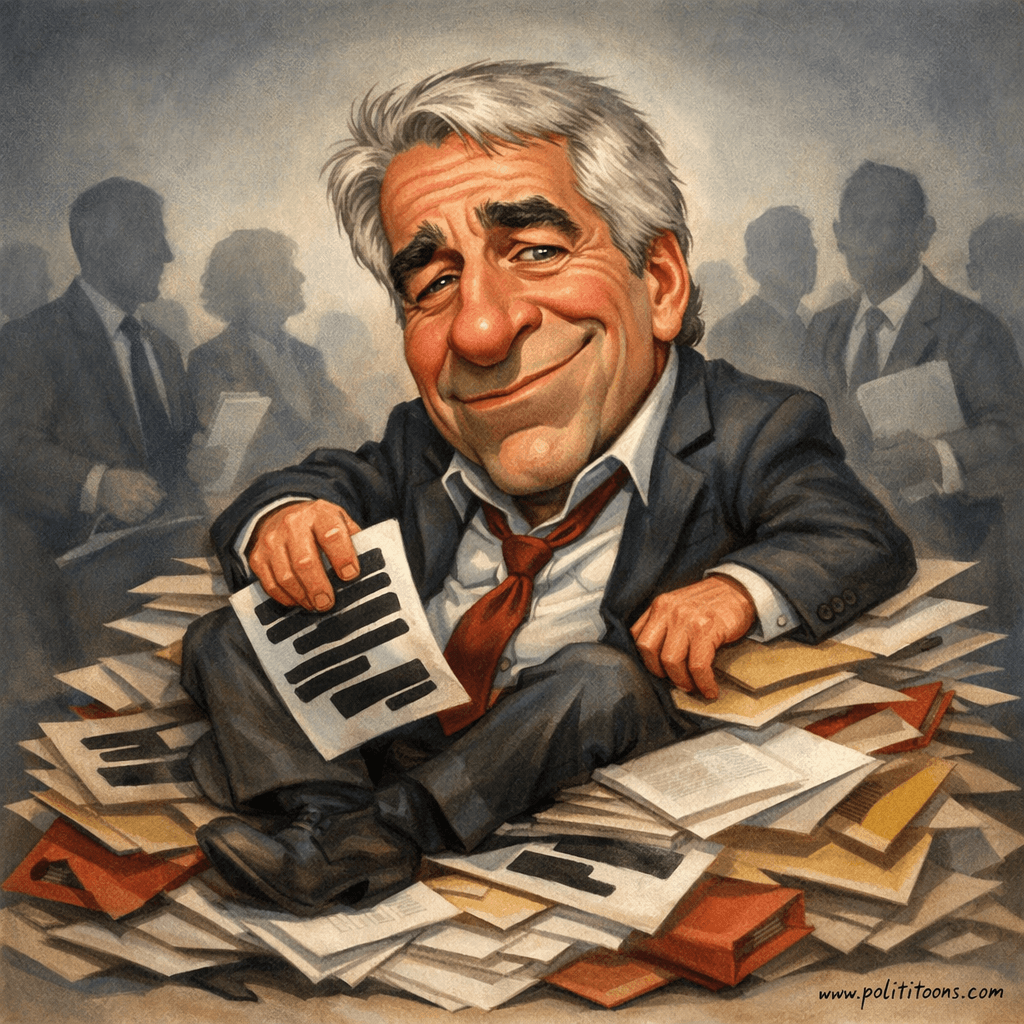
OBITUARY
Jeffrey Epstein’s Reputation: Death Announced, No Funeral Planned
An obituary for the tattered reputation of Jeffrey Epstein, which perished this week following fresh document releases, new allegations, and the loud memorial echoes of 'I don’t recall.' Fondly remembered only by NDA lawyers, it is survived by legacy denials, redacted PDFs, and the eternally busy memorialists of Congress.
By The Polititoons Editorial Board
The reputation of Jeffrey Epstein was finally laid to rest this week, aged approximately negative-seven, following yet another exhumation in the public square. His legacy was declared officially deceased following the release of new DOJ files, the resurrection of old scandals, and Les Wexner’s moving eulogy, in which Mr. Wexner assured mourners he 'never noticed a thing.' Flowers are neither expected nor recommended.
A Life in Public Disservice
Born in the late 20th century (precise age, not polite to ask), the public reputation of Mr. Epstein was conceived in ambiguity, raised in Harvard donations, and ultimately perished staring out from the latest batch of files like a moth drawn to a court summons. Those who tracked its erratic pulse over the years will recall an existence dogged by what obituary writers delicately call 'unhelpful friends': among them, supermodels who never borrowed his plane, Nobel laureates who popped by for a photo and an ethical blind spot, and, most recently, an 88-year-old billionaire whose memory, much like Epstein’s reputation, is now comfortably selective.
Epstein’s reputation soared in its precocious youth, unencumbered by the ties that generally bind lesser mortals—namely, a functioning moral compass and an allergy to federal indictments. He will be remembered for a Cambridge Associates printout thicker than a phonebook, a pilot’s log as crowded as the Tokyo subway, and an impressive ability to answer questions with 'I don’t recall,' a phrase which this week was handed down like a family heirloom to Les Wexner, predeceased only by the concept of institutional accountability.
Mourned mainly by apologists’ inboxes and the occasional self-deluding gatekeeper, the reputation departs leaving a gargantuan pile of emails, call sheets, and passively voiced press releases that amount to 'No one saw anything, no one heard anything, and certainly, no one remembers that party in St. Tropez, even if they lent the DJ their helicopter.'
The Early Promise
The credibility once attached to Mr. Epstein briefly flourished in the years preceding his passing, buoyed by the financial endorsements of men who now express regret with all the speed of a glacier making up its mind. His association with leading lights like Les Wexner was born, capsized, and posthumously disavowed in the grand tradition of plausible deniability—a hallowed rite now practiced weekly on Capitol Hill. Attentive readers will note that Wexner, in his moving homebound testimony, claimed to have 'never once in 36 years been unfaithful to Abigail,' a detail that, while touching, seemed to answer rather the wrong question.
In the final months of reputation’s brief renaissance, Epstein was beset by headlines less about hedge funds than about fences: no one could recall details, though several politicians are rumored to have sent thank-you notes to the phrase 'cannot recall,' soon to be engraved on the family crypt. Among Mr. Epstein’s surviving correspondences, one will find requests to Nobel Prize winners about 'how they're doing,' and a shelf of emails whose attachments are now so heavily redacted you could mistake them for modern art.
Fondly recalled by fellow party-goers who apparently missed the presence of 'dozens of red flags and at least a loudhailer shouting, “Regret this in 10 years,”’ Epstein’s reputation nevertheless briefly flirted with the world of the respectable. This period, full of expensive real estate, charitable foundations, and friendship bracelets for politicians, now lives on only in those campus buildings in Ohio stubbornly renamed without ceremony or, suitably, remorse. In lieu of tributes, mourners are encouraged to send their best memory hole, as the backlog in Washington is now considerable.
Cause of Death: Self-Inflicted Wounds
Official cause of death was a barrage of self-inflicted scandals, compounded by acute denial. Though many around the reputation noticed the early warning signs—ill-advised parties with super models, misplaced emails to Les Wexner, DNA-smeared dinner napkins—nobody appears to remember dialing emergency services—with the notable exception of House Democrats, who have called in the memorial press release squadron with the regularity of a national holiday.
The latest papers to emerge from the joyless crypt of the DOJ detailed new allegations from the 1990s, including bizarre references to human trafficking and electrical torture in private Surrey mansions—in what, for Epstein’s supporters, presumably became a cherished family tradition of not picking up the phone. The testimony was as vivid as it was, apparently, invisibly documented: Surrey Police, when finally paging through their digital ledgers this week—perhaps during lunch break—sadly announced that no such calls were ever logged. The memorial is expected to take place somewhere just as poorly attended.
Meanwhile, old acquaintances like Mr. Wexner have issued statements intent on surviving every association: 'I was naive, foolish, gullible,' he assured lawmakers in what was either a confession or the opening line to a contender for “Understatement of the Century.” In a moving tribute to collective amnesia, Democratic Reps. Lynch and Garcia led the memorial service for institutional memory, as the former described Wexner as 'lucid, if reluctant'; the latter, as crucial to Epstein's fortunes as oxygen is to fire, lamented that without these endorsements there 'would be no Epstein Island, no Epstein plane.' The legitimacy of reputation, having already been set alight, was by now only visible in rear-view mirrors. In lieu of tributes, the public is advised to investigate their own spam folders for emails from Sarah Kellen or Lesley Groff, both mourned by the concept of deleted history.
Survived By
Jeffrey Epstein’s reputation is survived by an incorruptible Wikipedia edit war, several Instagram thirst posts lurking in data centers, Les Wexner’s family trust (valued at last viewing as 'notional'), and the word-counters in University press offices sanitizing building entries with all the care of a biohazard specialist. Tributes continue from the peripheries: Nobel laureates who deny ever standing for photos (despite the evidence), supermodels who regret attending but not RSVPing, and stylists who, perhaps, would have lent him a private jet, had he actually returned phone calls.
No public funeral is scheduled, presumably lest mourners have their names appear in the inevitable next batch of document dumps. Survivors are invited to gather at discreet dinner parties and issue firm denials, a tradition going back decades. In honor of this unquiet passing, Congress has now called for additional testimonies from the Clintons—Americans holding their collective breaths for the prospect of a seating chart encompassing the Guest List of Misfortune, from Dasha Zhukova to the itinerant Woody Allen. Advocacy groups, meanwhile, have left the largest and most well-tended wreath at the door of Ohio State University, where officials may reportedly be seen performing exorcisms on signage in the dead of night.
In lieu of remembrance, the family invites the public to memorialize the words 'I have no recollection' and to attend the unveiling of Epstein’s final enduring monument: three thousand freshly redacted pages—each more empty than the legacy it lays to rest.