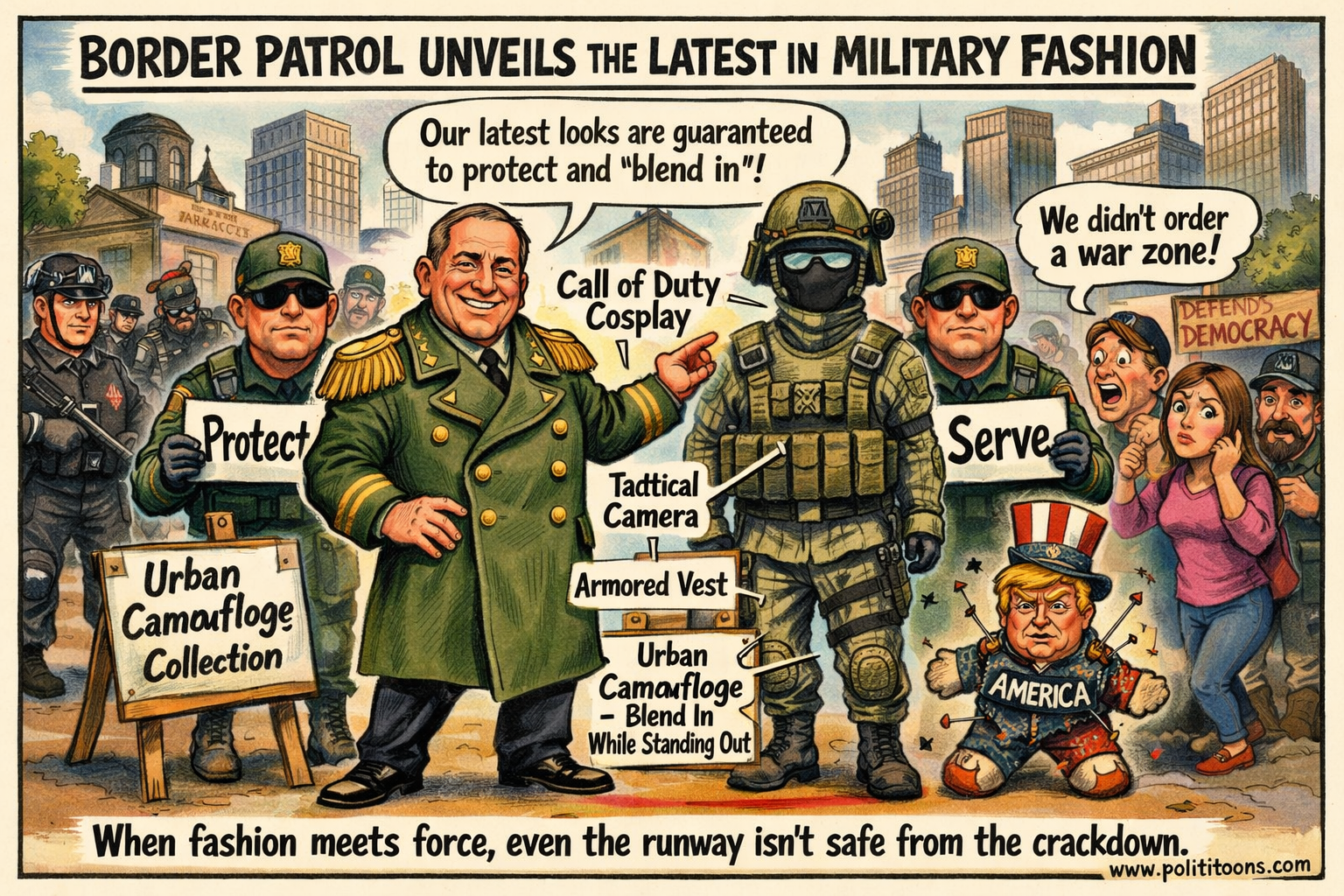
“Border Patrol's new fashion line: because nothing says 'protect and serve' quite like a wardrobe…”Sign up free to read this jokeGet unlimited access to our full archive of political cartoons and jokes.Sign up freeHeadline SourcesHere's a summary: **The Coat Controversy and What It Actually Signals** When Border Patrol Commander Greg Bovino appeared in Minneapolis wearing an olive double-breasted overcoat with brass buttons and epaulettes, critics on social media called it "Nazi cosplay." However, this criticism misidentifies the historical reference. The greatcoat style dates to the 19th century and has been worn by military forces worldwide, including Allied troops in WWII and even fictional characters like Doctor Who. **The Real Issue: Militarization** While the Nazi comparison misses the mark, the underlying discomfort points to something real—the increasing militarization of immigration enforcement. Uniforms matter for three reasons: they signal what an institution believes about itself, they shape public perception, and they influence how personnel see themselves. Research on "enclothed cognition" shows that clothing affects behavior—police uniforms, for instance, can heighten threat sensitivity and readiness to use force. **A Visual History of Change** In the 1950s, Border Patrol agents wore tailored uniforms projecting civil authority: cropped jackets, neckties, pressed trousers, and campaign hats drawn from police and cavalry traditions. Today's immigration enforcement looks dramatically different: ballistic helmets with cameras, armored vests, cargo pants, balaclavas, and camouflage patterns that serve no practical purpose on city streets but import the visual language of warfare. **The Consequences** This transformation encourages agents to see themselves not as civil servants administering law, but as combatants in hostile territory. The author suggests this shift may partially explain aggressive tactics in Minneapolis, including use of chemical irritants against demonstrators and the fatal shooting of 37-year-old Renée Good. The result is a self-reinforcing cycle: militarized dress fosters aggressive posture, which fuels public fear, which then justifies further militarization. When domestic agencies dress for war, they risk acting as if they're at war—even against the public they serve.via politico.com